
Eczema and the world. Making space for your rough and bumpy energies

In the March Dreambody Medicine Forum we began by answering questions. One was about how all the different aspects of our lives can be connected through our life myth. How symptoms, relationship, dreams, peak experiences, addictions etc may contribute and add some meaning to them.

Another question was about chronic symptoms and how to work with someone who wants the pain to go away. The answer was it depends on the individual depending on their life myth. Also about health in sickness and how it is important to make sure someone is getting support in every way possible and then to go a little into not just being against a symptom but finding out more about the power that may be in its energy.

The work in the middle was on eczema, dry bumpy patches of skin on the shoulders. They drew a picture to represent what it was like. A white patch surrounded by darker skin. Then enlarged the patch to include tiny dots in clusters. Reminding them of something feminine or floral.

There was a part that was against being rough and bumpy and tough but somehow they need to have access to that in some situations. Further exploration let to relationship and work issues. It brought out a complex situation they found themselves in doing research about an issue they were also involved in being part of the problem. They realized how all view points are needed to bring out tough issues.

There was a childhood dream of being oppressed and mothers coming and rescuing their children.

A question we discussed as a group was how is our symptom are involved in how we decide how to be in the world.

Sometimes with a symptom there is nothing you can do but follow what it wants. There is no way you can control it. And on the other hand if we follow its energy how this can be relieving. For example with a migraine the only thing you want is to be left alone and maybe you really need time alone.

It takes a deep focus to listen to our symptoms and find meaning in them. In them there are strong processes about the belief systems we have. Working in a group on a symptom can help us protect ourselves from the social norms and can help us develop our own beliefs and values.

Question:

What helps you remember to focus on your symptoms and explore their meaning?
2018 Dreambody Medicine Forums

To get notifications sign up to the pw-bulletin board string for reminders or like us on Facebook.

These forums are for everyone. People with all types of symptoms and care providers whether family members in home or medical professionals. Anyone with an interest in medicine and helping others.

In these forums we will link the individual experience of body symptoms with larger cultural and social issues.
You will have the opportunity to explore your own experience and learn the social aspects of illness through sharing your experience in a group format.


2018 Proposed Dates

March 16th

April 13th

June 15th

July 27th

September 14th

November 9th


Time: Fridays, 7.00pm to 9.00pm

Location:
The Process Work Institute of Portland
2049 NW Hoyt St,
Portland, OR 97209

Cost: Free, All Welcome

PLEASE NOTE: The Dreambody Medicine Forums are meant to accompany, not supplant or replace, the participants medical or psychological treatment for his or her illness. These forums are an educational experience, intended to enhance personal growth. We encourage participants to attend these seminars with their physicians or therapists approval.

Amazing Mucus – Exploring a sinus infection

Today we are sitting in the PWI library and next door a celebration is happening.

Our volunteer today wants to work on having sinus infections.  She has tried many treatments and knows what she is allergic to and what to avoid but still it continues.

There are many aspects to sinus infections that are disturbing, the pressure, the pain, the sneezing, the sore throat, the mucus. Today she decides to work on the mucus.

Amazing transformation

Using process work techniques she is supported in becoming the mucus and describes it as endless. It just keeps continuing. She gets to a point where she doesn’t know what to do with that and really doesn’t like mucus. In continuing to follow her body movements and becoming mucus, suddenly she changes and describes how amazing mucus is. It has the ability to transform itself, from liquid to solid, to be in many different places, and to be many different colors, it’s magical.

Practice in everyday situations

She discovers a freedom in really becoming it and encourages everyone to become it. Then she explores a family relationship and uses the freedom to ask for more contact. Next she explores a work relationship requiring leadership. Her challenge at work is how to be nice and friendly and to be a boss and have people meet the expectations of their job. With the freedom she found in mucus she quickly and clearly states the issue, and suggests a solution all the time staying related and friendly.

We briefly discuss broader issues of women and how difficult it is to be a leader. A new book is mentioned heard about on OPB radio by Robin Romm called Double Bind: Women on ambition.

How surprising and amazing the creativity that comes from using the energy found in a symptom to expand our identities and make changes in our experience.


Relaxed Focus

Emetchi-unfolding

Exploring the symptom maker

The January Dreambody Medicine Forum was visited by a raccoon climbing on the deck and gazing in the window at us. It seemed to arrive at certain moments when things got most interesting. I wonder what it was thinking.

In our introduction we talked about steps to exploring and unfolding a symptom experience such as noticing sensory grounded information, amplification, the symptom maker, expressing it creatively and how to bring it back into our lives. We also talked about the ethics around touch and how important it is to notice feedback.

Lower Back Instability

Then a woman worked on her symptom experience of instability in her lower back. It was a chronic symptom from childhood. The symptom experience consisted of burning, pain and twitching. It made her feel vulnerable, uncomfortable and unable to move quickly or lift things. She was working in a job using her body and had tried many different treatments.

Unfolding the most intense symptom experience started with her gripping a pillow with her hands, recreating the symptom as the symptom maker and led to her picking up the intensity with a sharp metallic focus.  It reminded her of her migraines that felt like an ice pick going through her head. The focus was also expressed through the intensity in her eyes.

This focused part was against another part. A part that is unfocused and unable to differentiate itself from others. Being unfocused also reminded her of her mother. She talked about how in her life she felt she had clear direction but it still felt unwieldy and her desire was for a sharper spiritual focus.

Effortless Focus

Further, the work led to the two parts coming together in finding a relaxed focus that was effortless. The facilitator then became a shaman like, wise grandmother and blew an intentional breath of relaxed focus into the symptom area which brought somatic relief. They talked to the sacrum, thanking it and inviting it to let go. At this moment the raccoon arrived and peeked in the window at us.

Bringing it back into her everyday life the idea was to take a moment to relax and check in inside herself first before focusing on what she needed to do in the world/life.

Connection of Symptoms to Relationships

Connecting with the group participants we talked in small groups about the following questions: How do you relate your body experiences to family system? Can you see any connection between a chronic symptom and relationship issues?

In the forum we explored roles and their many aspects. One role being of freedom to follow our own process and another that says it’s not the right way or timing. People shared personal stories about having body needs. Sometimes to let their bodies relax and play at other times to wake up and take care of the body’s needs. These included constipation and the immune system and bed wetting as a child. Another role was the need for safety. To check in on the feedback before going into something that may be uncomfortable for some. And a part that feels responsible and ends up cleaning up messes. At one moment there was an understanding of how you can make things safe by going at your own pace. In the end the person working on her symptom shared she was now able to understand her mother’s fears better.

Many thanks to everyone who was present for sharing and exploring symptom experiences together.

Mystery of Symptoms

Candle-Inner-movementIn our November forum we talked about the mystery of symptoms and our reactions to our symptoms. These experiences attract our attention but are discounted and ignored until we are forced to attend to them. How we relate to our bodies and how we decide to heal and determine if it is healthy or not, is a hugely political issue. You can’t just fight against your symptom, a part of yourself, fight for what is called “health”, and make a change unless you can also appreciate yourself in the moment. Accepting who you are in the moment, with all your vulnerabilities as well as supporting a non-traditional life experience with a symptom, is what we will explore.

We worked with someone’s experience of having a slipped disc.  We then discussed it’s movement and stillness. We talked about the experience of not feeling productive and how it contributes to depression. As a group, we also like to explore how a personal body symptom could be related to social issues in the world. At this point, the group acknowledged the recent terrorist bombings in Paris.

Back Symptom Experience

The symptom we explored was initially noticed as fatigue in her back. Then an accident exacerbated the symptom, which caused a slipped disc.  Two days later, she fell down stairs.   This amplified the symptom. Treatment helped and yet a year and half later there were still moments of pain without obvious reason. This made the symptom even more mysterious as she explained, “there is a part of me that doesn’t want to get better”. Our curiosity took us forward!

Two Parts

We ended up exploring the experience of loss. She experienced this as not feeling free or strong in her body. We separated two parts of the symptom. In role playing the symptom-maker, she prevented her everyday self from moving. By taking this seriously, “not moving” became very important.

In unfolding this part, it said, “doing things is pointless”. We explored the stillness. In this, she realized there was nothing to fix. This experience was just about being. From this stillness, she accessed a sense of detachment. Most importantly for her, this viewpoint brought an overview that “people are moving from the wrong place, creating chaos and confusion”. She indicated that coming from a place of being moved allowed a less chaotic expression of thoughts and feelings.

Waiting to be moved

In small groups a theme emerged regarding the connection between depression and stillness. There were different stresses related to either being productive or not productive. Shame and feelings of failure often accompanied the latter.   People feared turning inwards because of their expectation of finding nothing. They acknowledged a lack of social support to be internal or to take time to go inward. They identified this tendency as a way we collectively terrorize ourselves.  In the push to function we override the smaller deeper but also important information in the background.

We talked about how we speak just to say something rather than speaking from what moves us. By having access to the smaller deeper aspects of ourselves we find different ways participating.

We left with a sense of inspiration and model for how to touch into our deeper selves after seeing how to work with a body symptom in unpredictable ways.

Please join us at out next forum.


Believing in Our Experiences of Weakness

Frosty-leafIn the October forum we talked about Big and Small Health and the tyranny of wellness. Also, that true health means to be open to the diversity of experiences that we have.

We explored an individual’s experience of weakness from arthritis in their hands. Then in small groups we explored questions including: How do you deal with being held back by health issues and how significant is touch and movement in your health? In the discussion at the end we explored issues around expectations and responsibilities and the need for simplicity and play.

Arthritis Experience

This woman’s symptom experience was of having hands that get swollen and stiff, but no experience of pain. The symptoms especially occur when it is cold outside and lead to having trouble turning a key or zipping a jacket when the muscles just don’t work.

Paradox of Weakness

We explored many aspects of the symptom. These included the frustration of being weak and held back from being able to continue what she wanted to do. There was a critic that wanted her to shape up. A powerful aspect of the experience of the symptom was about being stiff and having to stop and wait which led to an awareness of needing to stand her ground. By listening to the wisdom to be found in aging and all that life has taught her she was reminded of being creative, her ability to find other options, as well as taking care of herself, wearing mittens, eating well, and being kind to herself.  Moving between all these parts resulted in a playful movement performance of different characters. She finished by reminding herself to believe in her own experience.

Finding Appreciation

In the forum we explored roles of expectations, pressure to do things and the judging that comes from this. Then we unfolded the various roles  and reactions after you get sick, afraid and life gets messy. The roles shifted from criticisms to genuine care and concern for each others’ health and vulnerabilities. A shift occurred allowing appreciation of ones accomplishments and the perseverance it takes in meeting expectations.  There was a part that was silly and slow and had loosen the communication format right from the beginning. It became impossible to ignore and helped the expectation side to relax a little. We became aware how we all share some kind of suffering and don’t know very much about each others lives.

If you like this post please share on facebook.

The Silent Tyranny of Normality

Yesterday in our Dreambody Medicine clinic we worked with a friend and colleague who is recovering from a severe car accident. She was struck by a semi-truck and spun around in her car until she hit the railings. Her car was totaled and by pure luck our friend survived the accident with “only” a concussion. Several weeks after the accident she asked to work on what she called her experience of her doctor called a post-concussion syndrome.
She said she felt not her normal self, which used to be sharp, thinking, verbal, focused, and able to achieve a lot. Now she felt low energy, unfocused, spacey, and had episodes of blurry vision. She fought with herself for not being able to live as usual and felt, sad, scared and ashamed of who she had become.
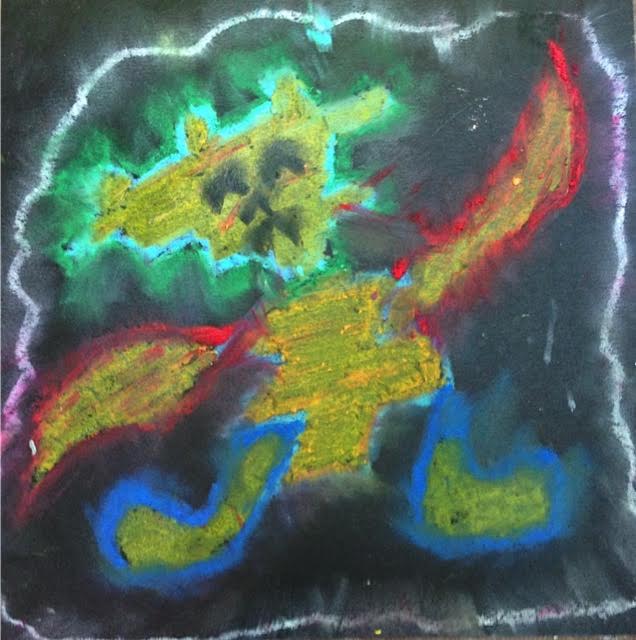
We asked her if she was willing to fully embody her “abnormal” self which she immediately did by collapsing in her chair and letting go of any pressure to do anything. She ended up on the floor going deep into a place of vast, dark space (below is the image she later draw of her experience). Internally she later told us she slowly allowed herself to let go of any expectations and experienced being silently with herself in the midst of the group.

Cathy 1

Easy & Not Easy-Learning to Let Go; September 12, 2015

As a group we then processed our own experiences of pressures to fit in, to be normal and of our difficulties to follow our own inner life and wisdom. Many shared their gratitude for witnessing the process and learning about their own struggles with letting go of the collective expectations. We experimented allowing ourselves to follow our playful natures, our unfocused dreamlike states and interacted with the voices that criticized us for being too unconventional, not “willing” to live a normal, structured and goal oriented life.
We also discussed the rank and privilege of letting go and the additional pressures underprivileged individuals might feel.
We all want to feel normal and fit in. We also all have experiences of being singled out and made feel ashamed of who we are by a teacher, a parent, a peer group for being too dreamy, speaking the wrong language, being the last chosen in a team selection process, coming from the wrong side of town, not having the cool gadget, being too skinny, too heavy etc… The collective pressure and tyranny to be like everybody else and disregard the beauty of our own diversity makes us sick.

Symptom Experiences That Keep You Awake

Cat-sleepingIn our April forum we talked about having curiosity about the physical and medical aspects of our symptom experiences as well as how they are related to who we are. They are connected to where we are in our momentary lives, found in our feelings and dreams. Our body reacts to what we think and experience and nobody knows how that works.  Those parts of ourselves that we don’t know so well and that we marginalize as a away to fit in our society can come back as a symptom experience to remind us of our wholeness.

We worked with two people and the two symptoms explored were Hasimoto’s Thyroiditis and lack of sleep. In the forum we shared some of the issues around sleep.

Hashimoto’s Thyroiditis

The first symptom experience was Hashimoto’s Thyroiditis. It is an autoimmune disease where the immune system attacks your thyroid.

There were two aspects to the symptom. One where the autoimmune system is oversensitive.  The other, where the low thyroid makes you slow and heavy. In her life she talked about being under pressure with changes in her life and being slow to respond to that. She was taking medication for the thyroid but it had no effect on her autoimmune system’s sensitivity to the thyroid tissues it destroys.

The autoimmune sensitivity was the area the person wanted to explore more. She made motions with her hands of the sensitivity, a very subtle feeling experience. Unfolding this hand movement led to a slow increasing irritation and frustration and then a desire for the other to join her to connect and engage. This led to a much more messy and random way of relating.

These two aspects played out in the persons process. Their sensitivity showed in holding back and being careful to not hurt one another. And there was a wrestling playful wild rough spirit that was looking to be matched.

She talked about her experience of being very careful when in relationships. The constraints of the conventional cultural ways of being a woman sometimes leading to the need to overwork to be seen as good as men and to be valued. Exploring how to be wild and playful and to be taken seriously in the world resonated with many in the group.

Lack of Sleep/Insomnia

The second we worked with shared his symptom experience of chronic lack of sleep. This was as a result of depression and anxiety and led to not sleeping for days on end. The most disturbing parts were not being able to regain a juice for life and mental clarity.

Here we tried to find out more about what was keeping the person awake. Something new wanted to be lived, and to be integrated into his life and work. This was not happening yet and there was a difficulty trusting in that. The issue included a need to move to a different city but not wanting to disrupt what he already had. This involved being supported in taking a risk and trusting intuition and inner knowledge.

At the end of the work we ended with a group process around sleep. Issues included how much sleep is needed and the diversity of sleep rhythms depending on lifestyles. Such as having to get up to go to work in the morning. Also mentioned was the pleasure of being awake to watch the sunrise and how sleep styles have changed over the years.

We so appreciate everyone who has taken the opportunity to work in the middle and everyone who has joined the forums for rich discussions of the social issues connected to symptoms.