
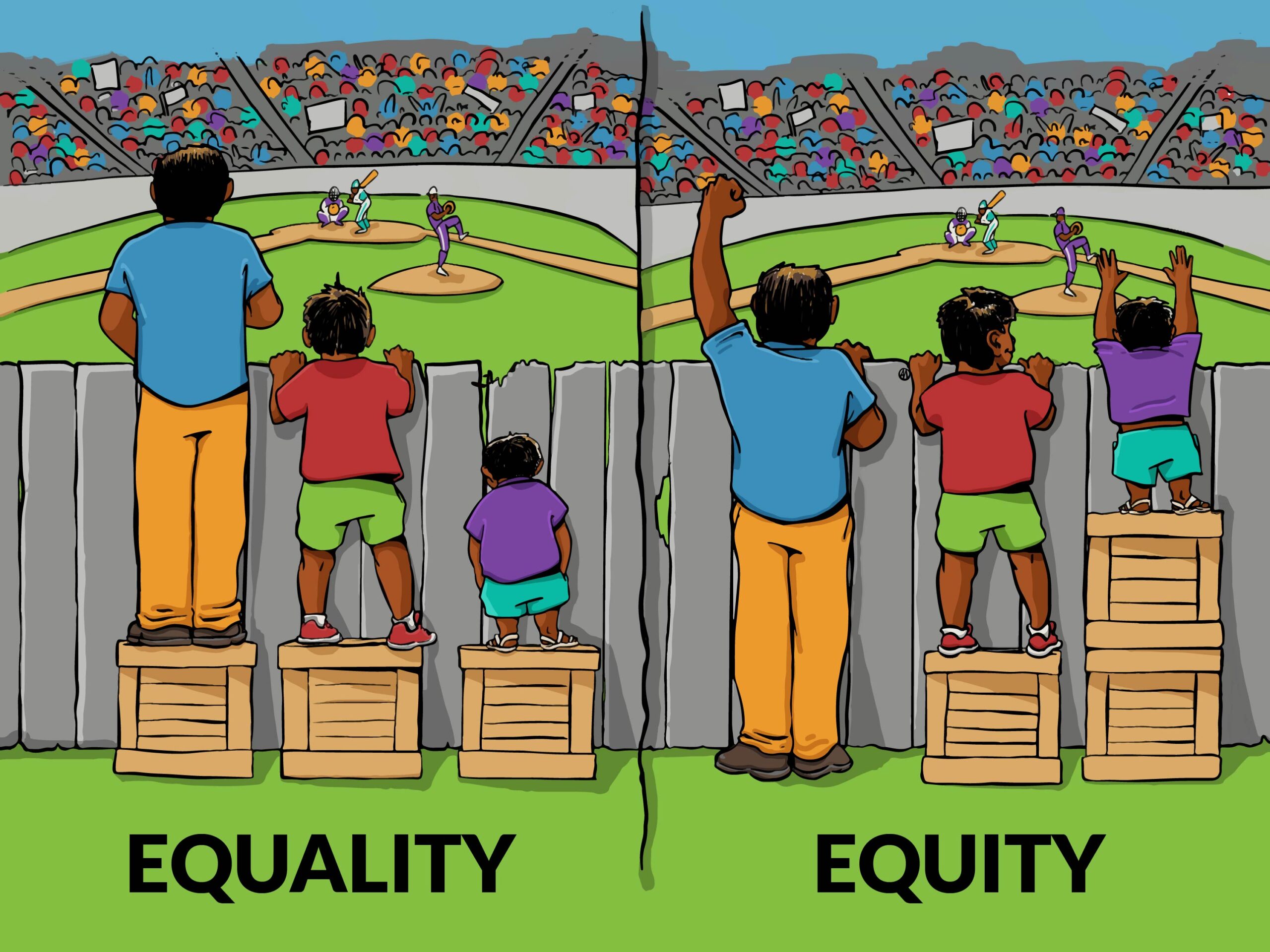
 I find this image by Angus Maguire (Interaction Institute for Social Change) very illustrative of the conversation between equality/equality of opportunity and equity/equality of outcome and the need for race consciousness as a step towards an ideal liberated state of colorblindness where race is not a factor anymore. The illustration is also helpful in analyzing health equity measures and policies.
Identity categories such as race, gender, sexual orientation, religion, and disabilities are grounds for ongoing serious individual and systemic discrimination. Individuals and whole communities are continuously wronged and deprived of the prospect of health and survival. This needs to be remedied and there are indeed especially strong reasons to dismantle the lingering effects of slavery that many African Americans experience.
In 1965, President Lyndon B. Johnson said in a commencement speech at Howard University: “You do not take a person who, for years, has been hobbled by chains, and liberate him, bring him up to the starting line of a race and then say, ‘You are free to compete with all the others,’ and still justly believe that you have been completely fair.”[1] This laid the ground for race conscious and identity-sensitive policies to achieve equality of outcomes, i.e. being able to watch the baseball game in spite of difference.
Equality of opportunity or the freedom to compete on an equal footing gives everybody the same access, crates, and cradles to achieving a certain goal. But we have, based on our group or racial identities, different lived experiences and suffer different impacts of unjust or oppressive policies. Thus, to correct the resulting social disparities or injustices and for achieving equality of outcomes or equity, we need affirmative actions, accommodations, or policies that prioritize disadvantaged groups. In sports this approach is being used when certain groups are given a handicap such as different teeing grounds for women and men in golf.
On the other hand, while certain differences such as gender-based body strength are difficult to erase, many barriers or fences can be reduced, lowered, or abolished. Providing crates or accommodation is not addressing the root causes of the injustices. And equity-oriented interventions can create their own problems. Deliberate inequality in the pursuit of social justice is problematic, especially in the health care field.
Race or identity sensitive policies were for example used in the early distribution of Covid vaccines and treatments. Because some of the vaccines and medications were initially scarce, some groups, that have been historically marginalized or discriminated against, were given prioritized access. This, instead of giving it to groups that would most benefit from access to treatment such as the elderly or immune compromised. In the US essential workers were given prioritized access instead of the elderly because marginalized groups were more represented among the essential workers than the elderly which then paradoxically resulted in more elderly people of color dying from Covid than if the elderly had been prioritized.
Let’s imagine good health being the playing field. There are obvious genetic and other biological factors that give you the ability to be a strong player. Then there are many meritocratic behaviors such as diet and exercise that improve your chances to become and remain a healthy player. Next, there are the systemic and structural barriers that hinder access to the good health playing field. Trauma, abuse, poverty, racism, sexism, trans-/homophobia, colonialism, and many other factors are processes that contribute to the fence that stands between marginalized people and the good health playing field.
We can also use Maguire’s illustration to examine some health equity measures. Medicare for All or another form of universal health coverage aims at giving everybody equal access to health insurance benefits. It reduces some of the systemic access barriers and gives everybody equal opportunity to receive health services. It doesn’t address other areas of social health injustices. The Affordable Care Act increased access to Medicaid benefits for many low-income Americans. Through its section 1115 demonstration projects it is now also piloting services that address health related social needs such as housing and environmental needs, a form of race- and identity-sensitive policy as it targets low income and marginalized communities. Many Medicaid health plans are also advancing culturally specific services by adding special payment differentials for culturally specific providers and in so doing they recognize the added challenges that culturally specific providers encounter. The introduction of traditional health care workers and peer support specialists into the Medicaid workforce is also an attempt to offset some of the health injustices that many low income and otherwise marginalized communities experience.
By focusing on group, race, or identity sensitivity and emphasizing difference and diversity we are now in danger of failing to address the actual barriers that obstruct integration or equal access to the playing field.
Accommodations such as affirmative action are reasonable as they help us understand difference, individual challenges, discrimination, and systemic barriers. But they are problematic in the sense that they don’t combat the inherent oppressions. The paying game visitors tolerate the unsolicited watchers outside the fence. The accommodating cradles give the onlookers equitable access to viewing the game from outside, but they don’t question the enclosures that keep them out. In that sense, accommodations mask privilege. They safeguard the balance of power which remains with the spectators that have the means to pay for the tickets to the game. They placate the moral guilt of the privileged spectators.
That is why some designer took Maguire’s illustration a step further and eliminated the fence or the barriers for inclusion and watching the baseball game. They call that new situation or story: liberation or justice. The vision is to create environments free of marginalization and oppression.
Aligning with the Canadian scholar of religious diversity Lori G. Beaman, I want to promote a new vision of deep equality [2]. The idea is to enrich the conversation of accommodations and equity. This will require a deeper understanding and valuing of diversity (diversity not only as a cause of discrimination) as well as the need for equal opportunity, integration, and collaboration. My picture would, in addition to getting rid of the fence, change the playing field. It would be a park in which mixed diverse teams would together decide on the game to play while others would play music, read a book, have a picnic etc.
For me, the norms and outcomes can and should shift, depending on the parties involved. They should be a result of a communal decision-making process. If they don’t, they can too easily lapse into sameness, “colonizing” norms or disrespect for difference. Deep equality includes both the elimination of discrimination, the celebration of difference, and fostering integration and collaboration.
Angus Maguire’s picture is the beginning of a conversation not the end. It highlights important points and while the focus on difference and race consciousness is important to understand social injustice, we need a focus on common ground and collaboration to help lower barriers and find better social arrangements and solutions. Color- and identity-blindness might remain an utopia but it is still a valid universal goal.
[1] Lyndon B. Johnson. To Fulfill These Rights. Commencement Address at Howard University, June 4, 1965. https://www.presidency.ucsb.edu/documents/commencement-address-howard-university-fulfill-these-rights; retrieved Feb. 15, 2023.
[2] Lori G. Beaman. Deep Equality in an Era of Religious Diversity. Oxford: Oxford University Press, 2017.